Travel & practical info
This page covers flights, airports, public transport, T-money, cards/cash, SIM/eSIM, accommodation areas, and useful travel passes.
Jump to: Flights · Airport → Seoul · Transport apps · T-money · Climate Card · Discover Seoul Pass · Money & cards · WOWPASS · SIM / eSIM · Accommodation · Electricity
Flights
- There are currently no direct flights between Norway and South Korea.
- You might be asked to fill out an arrival card on board. There is also an online e-Arrival Card system; see the Entry page for that.
- Incheon International Airport (ICN) is the main international airport near Seoul.
Airport → Seoul
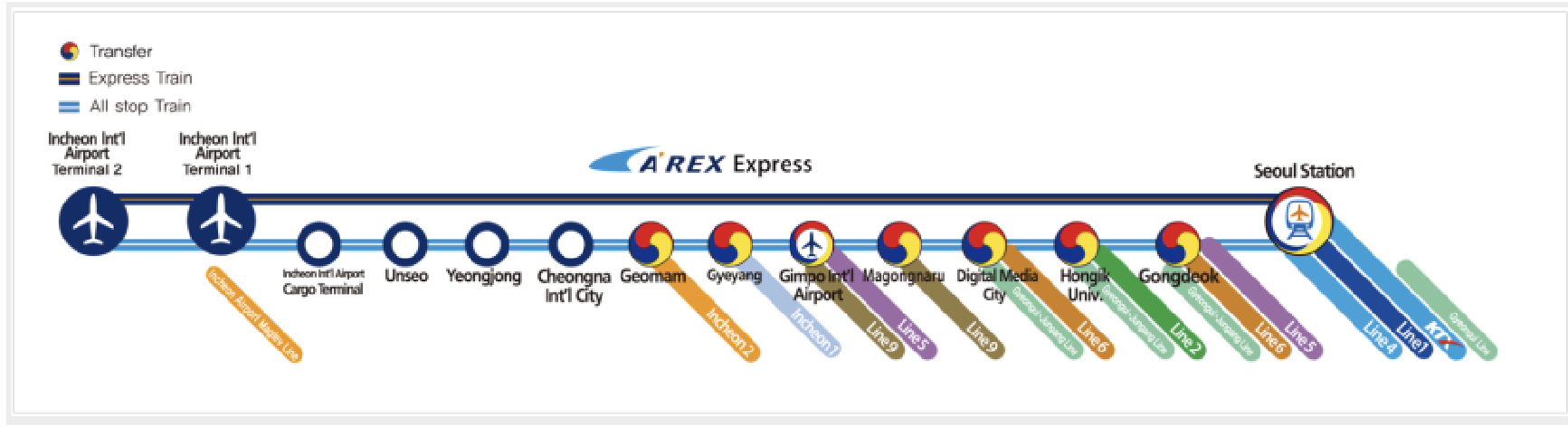
From Incheon International Airport, you can follow the airport signs to the airport rail / express metro.
Common stops:
- Seoul Station — around 10 stops / about 40 minutes
- Hongdae / Hongik Univ. — around 8 stops / about 34 minutes
There is also an airport shuttle, but the subway/airport rail is often easiest. If you stay somewhere else and are unsure how to get there, ask Max or Minji and they can help with a route.
Transport apps
Buses and the metro are well connected in Seoul and the surrounding areas. For navigation, these are useful:
- Naver Map
- Kakao Map
- Smart Subway
- Kakao T — taxi app
- Korail Talk — train tickets
- T-money GO
In Korea, Naver Map and Kakao Map are often more accurate than Google Maps for walking routes, public transport, and local places.
Useful links:
- Transport app overview: https://www.staykorea.org/ko/%ED%95%9C%EA%B5%AD-%EB%AC%B8%ED%99%94/%ED%95%9C%EA%B5%AD%EC%97%90%EC%84%9C-%EA%BC%AD-%EC%82%AC%EC%9A%A9%ED%95%B4%EC%95%BC-%ED%95%A0-%EC%B5%9C%EA%B3%A0%EC%9D%98-%EA%B5%90%ED%86%B5-%EC%95%B1-7%EA%B0%80%EC%A7%80-%28%ED%95%9C%EA%B5%AD-%EA%B5%90%ED%86%B5-%EC%95%B1%29/
- Seoul subway map: http://www.seoulmetro.co.kr/en/cyberStation.do
Rush hour can be very crowded:
- Morning: 07:30–09:00
- Evening: 17:30–19:00
Getting around: T-money
A T-money card is a rechargeable prepaid card used mainly for public transportation: subway and bus. It also works in some convenience stores and vending machines.
Where to buy
You can buy it at:
- Convenience stores: 7-Eleven, CU, GS25
- Subway stations
The card itself costs around 3,000 KRW.
Top-up
Important: T-money top-up is usually cash only.
You can buy the physical card with a credit card, but topping it up normally requires cash at convenience stores or subway station kiosks. You can buy and top up at the same time in convenience stores.
How to use it
Bus
- Enter through the front door by the driver.
- Tap when you get on.
- Tap again when you get off.
- The machine shows your remaining balance.
Subway
- Tap when entering the gate.
- Tap again when exiting the station.
Always tap both when you get on/enter and when you get off/exit.
Notes
- One card per person.
- T-money does not work for intercity trains.
- Do not top up too much at once — you can top up easily 24/7 at convenience stores.
- Refunds under 20,000 KRW can usually be done at convenience stores.
- For larger refunds, use T-money service centers at major subway stations or T-money Town at Seoul Station.
- It is usually a little cheaper and easier than buying individual subway tickets.
Example fares
These may change, but as a rough guide:
- Seoul bus: around 1,550 KRW one-way
- Bus outside Seoul: around 3,200 KRW, depending on distance
- Subway: around 1,600 KRW, depending on distance
Climate Companion Card
The Climate Companion Card is a public transportation pass in Seoul that offers unlimited rides on subways and city buses for a fixed period.
It can be useful if you plan to move around Seoul a lot.
You can buy a physical card at subway station vending machines or convenience stores. The physical card itself costs about 3,000 KRW, then you load a pass depending on how long you need it.
Approximate short-term pass prices:
- 1 day: 5,000 KRW
- 2 days: 8,000 KRW
- 3 days: 10,000 KRW
- 5 days: 15,000 KRW
- 7 days: 20,000 KRW
- 30-day pass: around 62,000 KRW
More information: https://english.seoul.go.kr/policy/transportation/climate-card/
Discover Seoul Pass
The Discover Seoul Pass is a sightseeing pass for visitors. It gives free entry to many major attractions and discounts at others.
It can save money if you plan to visit many tourist attractions in a short time, but check the included attractions first and compare it to your actual plan.
Useful for:
- First-time visitors
- People who want to visit many paid attractions
- People who want one pass for sightseeing planning
More information: https://www.discoverseoulpass.com/app/guide/index/passguide
Money & cards
Currency: Korean Won (KRW / ₩).
Cards are widely accepted, but some foreign cards may not work everywhere. Based on previous experience, some Korean payment terminals expect chip + signature or domestic PIN formats, which may differ from how Norwegian debit cards work.
Tap-to-pay / NFC is not fully supported everywhere for foreign cards.
Recommended:
- Bring more than one card if possible.
- Bring a credit card as backup.
- Contact your bank before travel and make sure international use is enabled.
- Carry some cash just in case.
ATMs are easy to find, including at ICN. If possible, use bank ATMs rather than convenience store or street ATMs, since those may charge higher fees.
Note for DNB debit card holders
Some travelers have experienced that certain DNB debit cards may be declined in Korea because DNB does not always support the chip + signature flow used by many Korean terminals.
In practice, this may mean that DNB debit cards do not work for many card payments, even if they work for ATM withdrawals. If this happens, withdraw cash or use another card.
Cards from other banks have reportedly worked better for some travelers, including Sbanken, Sparebanken Vest, Nordea, Storebrand, SpareBank 1 SMN, Danske Bank, and others.
WOWPASS
WOWPASS is a prepaid travel card for foreigners visiting Korea. It combines:
- Debit-card style payments
- Transportation card functionality
- Currency exchange features
You can use it at shops, restaurants, and convenience stores like a normal card. You can also tap it on subway, buses, and taxis like a T-money card, although the payment balance and transport balance are separate.
Other features:
- Load foreign currency and convert to KRW
- Check balances in the app
- Freeze the card in the app
- Withdraw cash from ATMs
- Get one from machines at airports or major subway stations
It costs around 35 NOK to issue and requires manual top-ups.
More information: https://www.wowpass.io/en
SIM / eSIM
It is usually easiest to buy a SIM card at the airport. The main operators are:
- SKT
- KT
- LG U+
You can also order before the trip from official telecom websites or travel platforms, then pick up at the airport when you arrive.
eSIM is also an option. Make sure your phone supports eSIM and is unlocked before traveling.
Examples:
- https://krsim.net/
- https://www.lguplus.com/korea-sim/eng/pc/product/simcard?tab=data-voice
- https://roaming.kt.com/eng/main
- https://www.skroaming.com/esim/esim
- https://chingumobile.com/
Accommodation
If you’re unsure where to stay, choose a hotel or Airbnb near a subway station.
Recommended areas:
Hongdae / Hongik Univ. Station
Young, lively, and popular with foreigners. Good for restaurants, cafés, bars, clubs, shopping, and nightlife.
Recommended if you want to be near the party scene.
Myeongdong / Myeongdong Station
Central and convenient. Popular with tourists. Good for shopping, cosmetics, street food, restaurants, and easy sightseeing.
Gangnam / Gangnam Station
Modern, busy, and more upscale. Farther from some central tourist areas, but closer to the wedding area than Hongdae/Myeongdong.
If you’re unsure whether a location or price is good, ask Minji.
Electricity
South Korea uses 220V, same as Norway.